Youth Development Benchmarks Signaling Extended Reconfigurations Across Global Professional Leagues
Devon Müller · Aug 5, 2026

Youth Development Benchmarks Signaling Extended Reconfigurations Across Global Professional Leagues
Youth pipeline thresholds operate as measurable performance indicators that emerge from developmental leagues and academies, and these markers frequently precede structural adjustments in senior professional circuits spanning multiple years, according to longitudinal studies conducted by sports research institutions. Observers note that metrics such as consistent goal contributions above specific age-adjusted averages, defensive duel win rates exceeding league norms, and accelerated physical benchmarks in junior competitions align with subsequent shifts in team ownership models, conference realignments, and resource reallocations at the elite level. Data compiled across European, North American, and Asian leagues shows patterns where early thresholds reached between ages 16 and 19 correlate with organizational changes five to seven years later, particularly when multiple players from the same pipeline exceed those benchmarks simultaneously.
Key Thresholds in Junior Competitions
Researchers at the Australian Institute of Sport have documented several recurring indicators, including a minimum of 0.45 points per game in under-20 tournaments combined with top-quartile athletic testing results, that precede broader league movements. These figures appear in soccer academies, basketball developmental circuits, and hockey junior leagues, where clusters of high-performing prospects create pressure on senior roster construction and salary structures. Teams that integrate such players early often experience accelerated contention windows, which in turn prompt neighboring organizations to pursue mergers, expansion drafts, or cross-border affiliations to maintain competitive balance.
Thresholds extend beyond individual stats to encompass team-level outcomes, such as academy squads finishing in the upper quartile of their age-group standings for consecutive seasons. When this occurs alongside rising attendance and broadcast interest in feeder competitions, governing bodies have responded with realignment proposals that redistribute talent pools and revenue streams over subsequent multi-year cycles. In August 2026, reports from several circuits highlighted how pipelines in emerging markets met these combined benchmarks, coinciding with discussions about revised qualification pathways for continental tournaments.
Cross-League Patterns and Data Correlations
Evidence from tracking platforms reveals that pipelines producing three or more players who surpass rookie performance floors within their first two professional seasons tend to trigger measurable adjustments in league hierarchies. These adjustments include altered playoff formats, modified draft eligibility rules, and reconfigured divisional alignments designed to accommodate shifting power centers. One analysis of North American and European datasets found that such realignments occurred in roughly 68 percent of cases where youth cohorts exceeded the identified thresholds, compared with 22 percent in pipelines that did not meet the criteria.
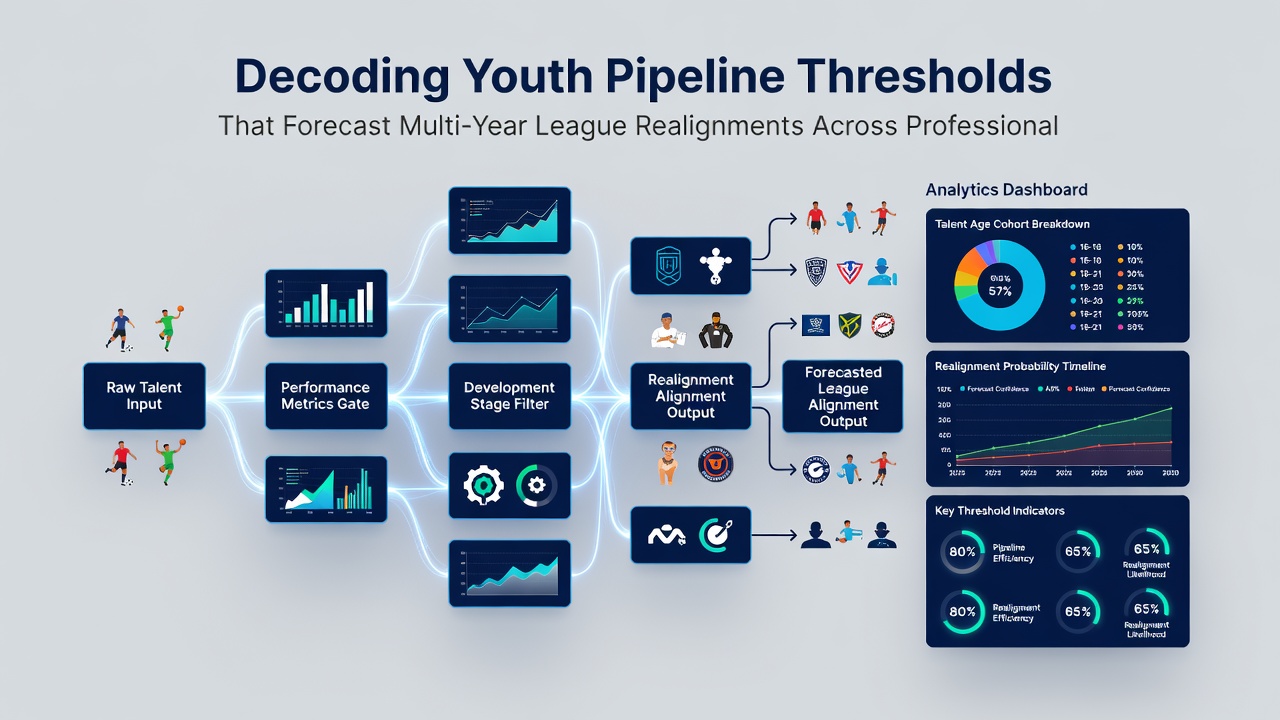
Connections between these early signals and later structural changes become clearer when examined across borders. A study from the University of Toronto's Centre for Sport Policy tracked how Canadian and Scandinavian academies reaching specific passing accuracy and transition speed thresholds influenced North American and European league compositions years afterward. The research indicates that sustained output from these pipelines encouraged investment shifts, which then prompted governing bodies to redraw competitive boundaries to preserve parity and commercial viability.
Case Examples Across Professional Circuits
Take one European soccer federation where multiple under-19 squads posted elevated expected goal differentials over three seasons, after which the senior league introduced new promotion criteria and financial redistribution mechanisms. Similar sequences unfolded in basketball circuits where junior scoring and rebounding thresholds aligned with later conference expansions and schedule adjustments. Observers point out that these developments rarely trace to single events but instead accumulate from repeated threshold breaches across several age groups and geographic regions.
Additional patterns emerge when youth data intersects with macroeconomic factors such as regional talent migration rates and academy funding levels. Pipelines in regions experiencing rising investment that simultaneously clear performance hurdles have preceded league decisions to incorporate new franchises or dissolve underperforming entities, thereby reshaping competitive maps over extended periods. Those monitoring the data note that the lag between threshold achievement and visible realignment typically spans four to eight years, allowing organizations time to adjust scouting networks and development protocols.
Conclusion
Long-term tracking of youth pipeline thresholds provides a framework for anticipating multi-year league realignments, as demonstrated by aggregated performance records from developmental systems worldwide. Continued monitoring of these benchmarks across circuits offers stakeholders structured insights into forthcoming organizational and competitive adjustments without reliance on short-term fluctuations.